The IMRaD Structure and Why It Exists
The standard structure of a scientific research paper — Introduction, Methods, Results, and Discussion, universally known by its acronym IMRaD — was not imposed arbitrarily on the scientific community. It evolved over the twentieth century as the discipline recognized that different kinds of information serve different functions for different readers, and that organizing information by function rather than by chronology or narrative arc makes papers easier to read, evaluate, and use Day, R. A., & Gastel, B. (2012). How to Write and Publish a Scientific Paper (7th ed.). Santa Barbara, CA: Greenwood.. Before IMRaD became standard, scientific papers were often written as narratives tracing the investigator’s path through the research, a format that was absorbing but inefficient. A researcher who wanted to know how a study was conducted had to read the entire paper to find out. A reviewer who wanted to evaluate the statistical methods had to search. IMRaD solved this problem by assigning each type of information to a designated section, allowing readers to navigate directly to what they need.
Understanding why each section exists clarifies what each section should accomplish. The Introduction establishes context: why was this question worth investigating, what did prior work establish, what gap or uncertainty remains, and what specific question or hypothesis did this study address? The Methods section provides a blueprint: a description of what was done in sufficient detail that a qualified researcher could, in principle, reproduce the study. The Results section presents the findings: what the data showed, organized around the study’s research questions, without interpretation. The Discussion section interprets: what the findings mean, how they relate to prior work, what limitations constrain their interpretation, and what questions they leave open. This four-part structure is not merely a stylistic convention; it reflects a logical decomposition of the scientific argument into its constituent elements.
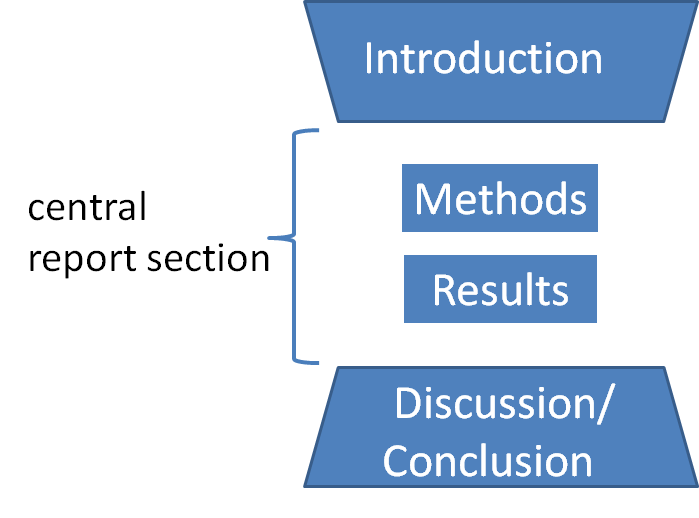
Some journals use variations on IMRaD. Clinical case reports typically follow a different structure. Review articles may use a thematic organization rather than the standard sections. Short communications and letters to the editor often abbreviate the structure considerably. But IMRaD, or a recognizable variant of it, governs the vast majority of primary research reports in the life sciences, and mastering it is the most important single writing skill a new researcher can develop.
Writing the Introduction
The Introduction of a scientific paper has been likened to a funnel: it begins broadly, situating the research question in its field, and narrows progressively toward the specific question or hypothesis being tested. This funnel structure is not merely a metaphor; it describes a logical movement from general to specific that helps readers understand why the specific question matters by situating it in a larger context of knowledge and uncertainty.
The Introduction typically accomplishes three things in sequence. First, it establishes the importance of the topic: why does the field care about this area? This might involve citing the disease burden of the condition being studied, the fundamental biological question at stake, or the practical problem that a technological or methodological advance might solve. Second, it surveys the relevant prior literature: what is known about this topic, and what has prior work established? This survey should be selective rather than exhaustive — a paper’s introduction is not a systematic review — and it should be organized around logical themes rather than as a chronological list of prior findings. Third, it identifies the specific gap, uncertainty, or question that the current study addresses, and states clearly what the study did to address it. This final element — often called the “gap statement” and the “study aim” or “study objective” — should be explicit and specific. Vague statements of aim (“to investigate the role of X in Y”) are weaker than specific ones (“to test whether genetic ablation of X in adult mice impairs Y by comparing performance on Z tasks relative to wild-type controls”).
The quality of scientific writing in the Introduction depends on more than logical organization; it depends on sentence-level clarity. The principle articulated by Gopen and Swan Gopen, G. D., & Swan, J. A. (1990). The science of scientific writing. American Scientist, 78(6), 550–558. — that readers naturally expect new and important information to appear at the end of a sentence, in the position they call the “stress position,” while familiar context belongs at the beginning — is one of the most practically useful guidelines for scientific prose. A sentence that buries its key information in a subordinate clause or a parenthetical loses the emphasis that the information deserves, while a sentence whose stress position is occupied by familiar information creates a subtle sense of anticlimax. Applying this principle systematically, across a full section of writing, produces prose that feels authoritative and easy to follow — not because the words are simpler but because the information is arranged the way readers expect to receive it.
Writing the Methods
The Methods section is the blueprint of the scientific paper, and its primary criterion for success is reproducibility: a qualified researcher reading the Methods should be able to repeat the study. This standard determines what must be included and at what level of detail. Procedures that are completely standard and universally understood do not require elaboration; procedures that are novel, modified, or specific to the laboratory require sufficient detail to allow independent execution. The key question for every methodological decision is: would a researcher unfamiliar with my specific protocol know exactly what I did?
The Methods section is conventionally written in the past tense and, in most life sciences journals, uses the passive voice to describe procedures, though the convention on voice varies by journal and is discussed further below. It should be organized into logical subsections — participants or subjects, study design, procedures, outcome measures, statistical analysis — that allow readers to find specific information without having to read the section linearly. The statistical analysis subsection deserves particular attention: it should specify not only which tests were used but why they were appropriate for the data, what the primary and secondary outcomes were, and how missing data, outliers, and protocol deviations were handled. Post hoc statistical decisions that are described in the Methods as if they were pre-specified obscure the degree to which the analysis was exploratory — a form of misrepresentation that, even when not intentional, contributes to the inferential problems discussed in Chapter 5.
Ethical approvals — IRB or IACUC protocol numbers, consent procedures, compliance with relevant reporting guidelines — should be reported in the Methods. For clinical trials, the trial registration number and registry should be given. For studies using established cell lines, reagents, or animal models, the specific source and any relevant characteristics should be specified. For computational studies, the software, version numbers, and parameter settings used for all analyses should be documented.
Writing the Results
The Results section presents what the study found. It does not interpret, discuss the implications, or compare the findings to prior work — those functions belong in the Discussion. The Results section reports the data: what the measurements showed, how the groups compared, what the statistical tests indicated. Maintaining this discipline — resisting the impulse to interpret as you describe — produces a cleaner section and a more coherent paper overall.
A practical strategy for writing the Results section is to begin by organizing the figures and tables that present the data, and then to write the text of the section as a narrative that guides the reader through those figures and tables in logical order Day, R. A., & Gastel, B. (2012). How to Write and Publish a Scientific Paper (7th ed.). Santa Barbara, CA: Greenwood.. Figures and tables should be able to stand alone — their titles and legends should be sufficiently complete that a reader could understand what they show without reading the main text — but the text of the Results should not simply repeat what is shown in the figures. Instead, the text should draw attention to the most important findings, highlight the key comparisons, note any unexpected results, and guide the reader through the logical sequence of the analysis.
Statistical reporting in the Results should follow the conventions of the field and the specific guidelines of the target journal, but some principles are universal. Effect sizes should be reported alongside p-values, because statistical significance alone is not a measure of practical or scientific importance. Confidence intervals, which communicate both the magnitude and the precision of an estimate, are generally more informative than p-values alone and should be reported wherever possible. When multiple comparisons are made, the approach to multiple comparisons correction should be specified and consistently applied.
Writing the Discussion
The Discussion is the section in which the researcher interprets the findings, situates them in the context of prior literature, and draws conclusions. It is often the most intellectually demanding section to write, because it requires the author to move between levels of abstraction — from the specific results of this study to the general implications for the field — while maintaining logical coherence and appropriate epistemic humility about what the findings do and do not show.
A well-structured Discussion typically begins by restating the main finding in one or two sentences — not a repetition of the abstract but a clear statement of what the results showed, framed in terms of the question posed in the Introduction. It then interprets that finding: what does it mean, mechanistically or theoretically? It next places the finding in context: how do the results compare to prior work? Agreements with prior findings strengthen conclusions; disagreements require explanation. The Discussion should engage with contradictory evidence rather than ignoring it — a finding that is consistent with a hypothesis and also consistent with every prior finding in the literature is more convincing than one that agrees with some prior work but conflicts with other prior work that the author has chosen not to mention.
Acknowledging limitations is not a sign of weakness; it is a mark of scientific honesty and rigor, and reviewers and readers will note the absence of a candid limitations discussion as a red flag. Limitations that commonly deserve explicit discussion include sample size and statistical power (if relevant), generalizability of the findings, potential confounders in observational studies, the reliance on surrogate rather than clinical outcomes, methodological assumptions that could not be independently verified, and the cross-sectional or short-term character of an investigation into what may be a dynamic process. The goal is not to undermine confidence in the study but to accurately characterize the strength of the evidence and help readers calibrate their conclusions accordingly.
The Discussion typically concludes with a statement of broader significance — why the findings matter beyond the specific context of the study — and, often, a brief description of the most important questions the work leaves open and that should be addressed in future research. This forward-looking conclusion connects the completed work back to the ongoing cycle of inquiry from which it emerged and into which its findings will be incorporated.
The Abstract
The abstract is the section of the paper that will be read most widely. Many readers will encounter only the abstract — through database searches, journal alerts, and social media sharing — and will never read the full text. The abstract therefore carries a disproportionate responsibility for communicating the study’s question, methods, results, and conclusions accurately and accessibly.
Most journals in the biomedical sciences use a structured abstract format with explicitly labeled sections corresponding to the paper’s major elements: Background (or Objectives), Methods, Results, and Conclusions. The structured format, which became standard in many journals during the 1990s, ensures that all essential information is present and easily located. Unstructured abstracts — a single paragraph without labeled sections — remain common in some basic science journals and in letters or short communications. Whether structured or unstructured, the abstract should be self-contained: it should not include references, should not use unexplained abbreviations, and should give quantitative results (with statistical measures) rather than vague qualitative characterizations.
The practical advice to write the abstract last is almost universally given and almost universally correct. The abstract summarizes the paper; it can only be written accurately once the paper exists. A common approach is to write one or two sentences for each section of the paper — the question, the design, the sample, the primary outcome, the statistical approach, the main finding, and the principal conclusion — and then to edit these sentences into a coherent, concise paragraph or structured summary. The final abstract should be checked against the full text of the paper to ensure that it accurately represents the methods used, the results obtained, and the conclusions drawn.
Writing Clearly: Voice, Jargon, and the Revision Process
The debate over active versus passive voice in scientific writing has occupied more column inches in writing guides than its practical importance perhaps warrants. The conventional wisdom — still dominant in much of biomedicine — holds that scientific writing should use the passive voice to preserve the appearance of objectivity (“samples were centrifuged” rather than “we centrifuged the samples”). The counterargument, advanced by science writing instructors including those who have influenced journal style at outlets like Nature and Science, holds that active voice is clearer, more direct, and no less objective — that the passive voice often obscures agency and produces verbose, unnecessarily complex sentences Gopen, G. D., & Swan, J. A. (1990). The science of scientific writing. American Scientist, 78(6), 550–558.. Both positions have merit, and the appropriate choice often depends on the specific sentence rather than on a blanket policy. What matters most is clarity: the sentence that communicates most precisely and efficiently, regardless of its grammatical voice, is the better sentence.
Jargon presents a related challenge. Every scientific field develops specialized vocabulary that allows efficient communication among insiders but creates barriers for outsiders. Some technical terms are genuinely necessary — there is no everyday synonym for “phosphorylation” that is more precise — and using them is appropriate and efficient for a specialist audience. But technical terms used out of habit, terms that could be replaced by simpler language without loss of precision, and acronyms that are introduced and then not used again all impose costs on the reader without providing compensating benefits. Writing for the broadest reasonable audience — not dumbing down the science, but not unnecessarily restricting access to it — is a practice that improves scientific communication across the board.
Authorship and the Writing Process
Authorship on scientific papers carries both credit and responsibility, and the criteria that determine who qualifies as an author have become increasingly formalized in response to high-profile cases of guest authorship (adding famous names who made no contribution to enhance a paper’s chances of acceptance) and ghost authorship (omitting the names of people — often industry employees — who played a significant role in the work) International Committee of Medical Journal Editors. (2023). Recommendations for the Conduct, Reporting, Editing, and Publication of Scholarly Work in Medical Journals. http://www.icmje.org/icmje-recommendations.pdf. The International Committee of Medical Journal Editors (ICMJE) has defined authorship criteria that are now widely adopted: to qualify as an author, a contributor must have made substantial contributions to the conception or design of the work, or to the acquisition, analysis, or interpretation of data; must have drafted or critically revised the work for important intellectual content; must have approved the final version; and must be accountable for all aspects of the work. Contributors who meet some but not all of these criteria should be acknowledged rather than listed as authors.
The practical writing process for a multi-author paper involves coordination, negotiation, and iteration. A common approach is for the first author (typically the investigator most responsible for the work) to produce initial drafts of each section and to circulate them to co-authors for revision. Comments and revisions from multiple co-authors must be integrated, which requires clear communication about priorities and a process for resolving disagreements. Version control — whether through shared document platforms like Google Docs or through a system of clearly named file versions — is essential to avoid the confusion of multiple divergent drafts circulating simultaneously.
The revision process is not a final-stage tidying; it is where much of the real writing happens. Most experienced scientific writers report that their first drafts are rough and that the quality of their writing is determined primarily by the number and care of their revisions. Reading the paper aloud, having it read by someone unfamiliar with the work, setting it aside for several days before rereading it — all of these strategies help writers identify passages that are unclear, arguments that are incomplete, and sections that are out of proportion. The investment in thorough revision pays off not only in better writing but in faster peer review, since clearly written papers are easier for reviewers to evaluate and are less likely to generate requests for clarification that delay the publication process. Clear scientific writing is not merely an aesthetic virtue; it is a form of respect for the reader’s time and an obligation to the enterprise of science itself Perkel, J. M. (2020). How to write a superb manuscript. Nature, 583(7815), 129–130. https://doi.org/10.1038/d41586-020-01924-4.
Bibliography
- Day, R. A., & Gastel, B. (2012). How to Write and Publish a Scientific Paper (7th ed.). Santa Barbara, CA: Greenwood.
- Gopen, G. D., & Swan, J. A. (1990). The science of scientific writing. American Scientist, 78(6), 550–558.
- International Committee of Medical Journal Editors. (2023). Recommendations for the Conduct, Reporting, Editing, and Publication of Scholarly Work in Medical Journals. http://www.icmje.org/icmje-recommendations.pdf
- Perkel, J. M. (2020). How to write a superb manuscript. Nature, 583(7815), 129–130. https://doi.org/10.1038/d41586-020-01924-4